“I only put on a mask at a masquerade”
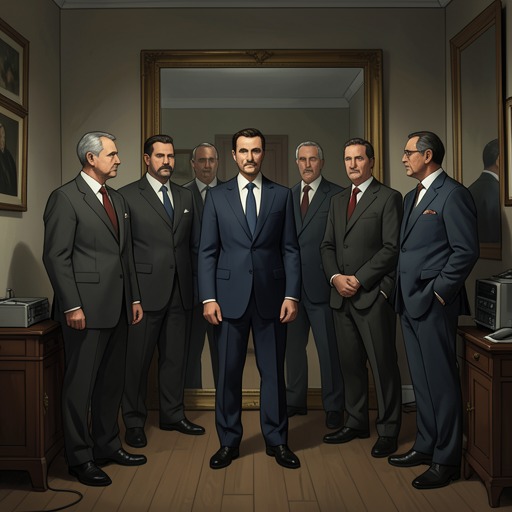
The Double“I only put on a mask at a masquerade” is Yakov Petrovitch Golyadkin’s recurring claim that he is honest in everyday life, unlike the duplicitous people he believes surround him. Its force comes from the distance between the principle he proclaims and the scenes in which he tries to enact it: he carefully manages his appearance and explanations, yet colleagues and party guests respond with suspicion, laughter, or coldness. The mask is at once his figure for social deceit and an image of the self-presentation he cannot reliably command.
The Claim of Plain Dealing
The expression first appears in Golyadkin’s appeal to Krestyan Ivanovitch Rutenspitz. He describes himself as an insignificant man who is proud of his modest position, rejects intrigue, and claims to act openly rather than by hidden or devious methods. In that carefully emphatic account, the masquerade mask marks a boundary: disguise belongs to a literal festive occasion, not to ordinary dealings between people. He asks how one should take revenge on a malignant enemy, but the doctor does not enter into the moral drama Golyadkin is constructing. Instead, Krestyan Ivanovitch says that he does not understand the point and turns to writing a prescription. The contrast makes the declaration less like a shared principle than an anxious bid to have Golyadkin’s account of himself recognized.
The statement also gives Golyadkin a vocabulary for accusation without requiring him to identify his supposed opponents directly. He condemns insinuation, slander, and duplicity, then speaks of an enemy and asks how that enemy should be answered. His insistence on openness is therefore bound up with suspicion: he presents himself as the man who refuses covert tactics while imagining that other people employ them against him. The distinction between a mask worn at a masquerade and one worn in daily life sounds clear in the abstract, but his conduct and circumstances keep making that distinction unstable.
From Personal Defense to Public Address
When Golyadkin speaks to clerks at the government office, he returns to the same self-description in a more openly defensive register. He says that they have known him only on one side, then argues that some people reject roundabout methods, refuse to define human worth by “polishing the floor with their boots,” and will not claim to be content merely because their trousers fit. He sets his stated independence against fawning, aimless social display, and meddling. The mask now belongs to a larger portrait of the person he wants his colleagues to recognize: modest in rank, unwilling to abase himself, and distinct from those who seek advancement by ingratiation.
The appeal does not secure that recognition. The clerks wink at one another, and when Golyadkin finishes by asking leave to withdraw, they burst into laughter. He answers that they may laugh for the moment, but that they will see in time, then retreats with his hat. His speech attempts to define the terms on which he should be judged; the listeners’ laughter turns the occasion into a judgment he cannot control. The recurring mask claim thus carries a practical contradiction: Golyadkin presents verbal candor as proof of his integrity, but the public performance of that candor exposes him to further embarrassment.
A Theory That Turns Back on Its Speaker
Later, in conversation with Anton Antonovitch Syetotchkin, Golyadkin describes mask-wearing as a general modern habit. He proposes that people who wear masks have become common and that it is now difficult to recognize the person beneath one. When Anton asks whether recognition is really so difficult, Golyadkin clarifies that he means himself: he wears a mask only when one is literally needed at carnival or another festive gathering, not in everyday life in the less obvious sense. The exchange shifts the phrase from a personal motto to a theory of social appearances, but Golyadkin’s qualification also shows how much effort he must spend making his honesty intelligible.
Anton does not pursue the distinction. He says that he has no time for further arguments, gathers papers, and returns to his work, adding that Golyadkin’s business will be explained in due course and that he will see whom to blame. Golyadkin begins to protest that he meant no such thing, but Anton is already moving away. Once again, the attempt to explain himself does not produce the mutual understanding he seeks. The mask metaphor names a concern that is central to Golyadkin, while his interlocutor treats it as an interruption to official business.
The Social Scenes That Complicate the Motto
The narrative repeatedly places Golyadkin’s claims about plain dealing beside situations in which appearance and audience matter. At the start of his carriage journey, he admires his newish clothes and boots; after setting off, he chuckles as if pleased with a successful performance, then becomes anxious and watches passers-by, adopting a decorous air whenever he thinks someone is looking. On Nevsky Prospect he sees two junior colleagues, hides in the carriage, and rationalizes their surprise at seeing him ride in one. When Andrey Filippovitch, the head of his office, passes in a fashionable droshky and recognizes him, Golyadkin blushes. The passage does not simply establish that he is pretending to be someone else; it shows his self-presentation changing with the gaze he imagines upon him.
The contrast becomes especially sharp at Olsufy Ivanovitch’s birthday celebration for Klara Olsufyevna. The narrator first dwells on the sumptuous dinner, the formal toasts, the dancing, and the guests’ polished sociability, while Golyadkin waits for nearly three hours in a cold, dark back-stair landing, concealed between a cupboard and an old screen. He tells himself that he is only waiting and can enter when the time is right. When he finally crosses into the rooms, he jostles guests, tears an elderly woman’s dress, and stumbles toward Klara. He manages the congratulations, but stammers over his good wishes; the room falls silent, then laughter follows. Andrey Filippovitch turns away with Klara, and Golyadkin tries to retreat to a corner and pass as an unconcerned spectator. The episode sets the formal social world he has been watching against his failed effort to enter it without losing face.
Afterward, at the government office, Golyadkin again finds his reception governed by other people’s responses. Colleagues answer his greeting coolly, decline to shake hands, or turn away; younger clerks gather around him with what the narration calls insulting curiosity. Then Yakov Petrovitch Golyadkin junior appears among them, smiling, nimble, and fawning. In this setting, the motif of masks resonates with the visible contrast between the two Golyadkins, but the supplied scenes do not resolve that contrast into a simple explanation of who is deceiving whom. What they do show is that the senior Golyadkin’s insistence on a transparent self cannot prevent others from making him an object of scrutiny.
Irony, Performance, and Exposure
The motif’s irony depends on the difference between Golyadkin’s avowed principle and the social action surrounding it. He condemns masks as daily duplicity, yet repeatedly arranges his appearance, rehearses how to justify himself, and tries to look properly placed before an audience. At the party, he invokes familiar formulas about not intriguing and not “polishing the floor with their boots” even as he enters uninvited and becomes the center of attention. These actions do not prove that his declared honesty is false; rather, they show that sincerity alone cannot determine how an utterance will be received or how a person will appear within a rigid social setting.
The birthday scene sharpens the point through the narrator’s own manner. The celebration is rendered in deliberately elevated, ceremonious language, with the narrator professing an inability to do justice to its brilliance, before attention returns to Golyadkin waiting among the back-stair clutter. That shift makes public decorum and private anxiety occupy adjacent spaces: the polished ball is not merely a backdrop but the spectacle from which he watches, then into which he forces himself. The mask expression belongs to this same tension between the appearance a social occasion demands and the identity Golyadkin insists is his own.
His later reaction to a letter signed by Klara provides a further scene of exposure. After reading it, he walks up and down in agitation, apparently gesturing and speaking words that draw the attention of everyone in the room. He then notices hostile, suspicious looks and sees that his clothes are muddy and torn. The passage does not repeat the masquerade formula, but it recalls the problem the expression names: Golyadkin’s self-understanding and the impression made on witnesses have come apart. Across the doctor’s consultation, the office conversations, the carriage, and the birthday gathering, the claim that he wears a mask only at a masquerade becomes less a stable assurance than an increasingly strained attempt to control the terms on which he is seen.